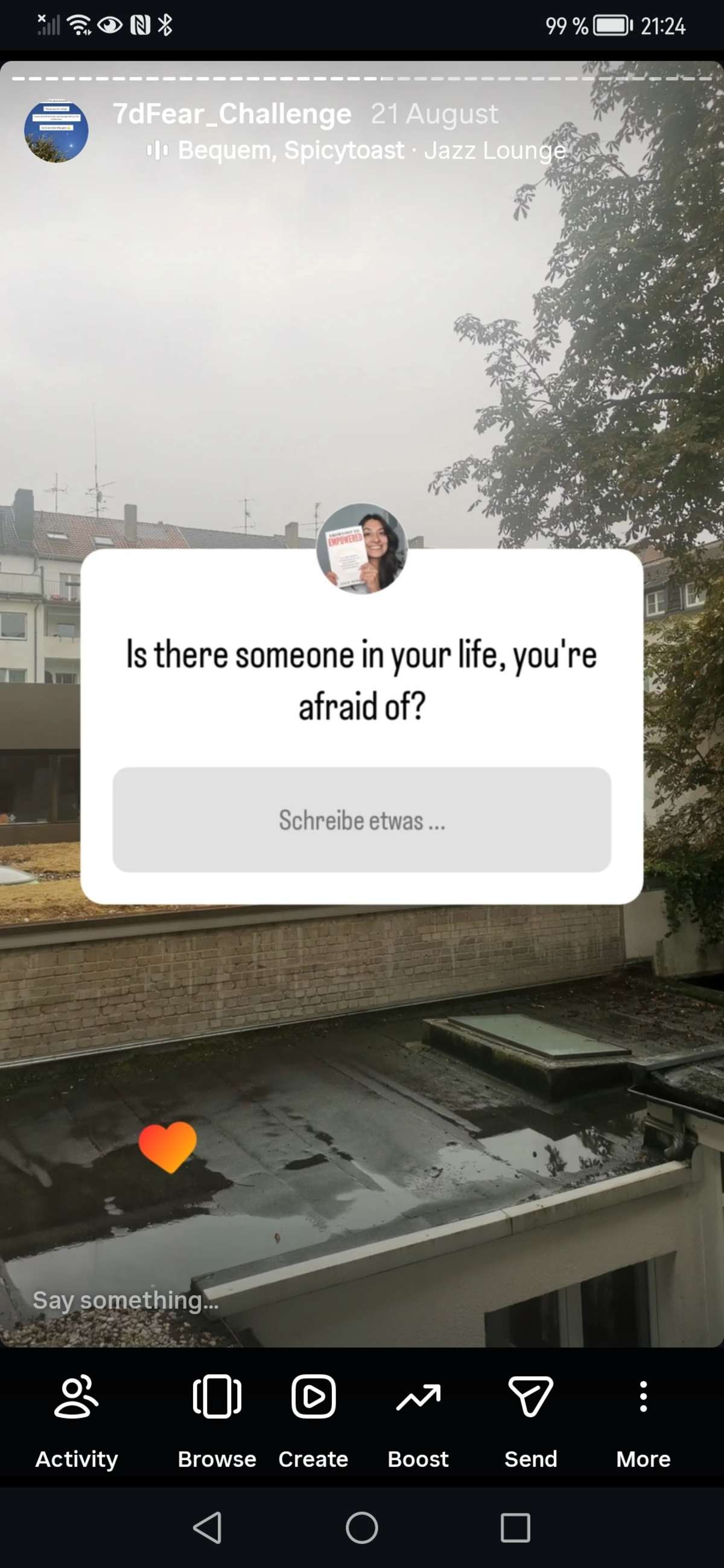
As promised, it’s time to tell you about the 7‑day fear challenge I posted on my Instagram stories. The idea was simple: do one thing I was afraid of every day for 7 days. It started as a personal experiment, but it ended up doing a lot more good for me than I expected.
At the beginning, I struggled to find things I was afraid of that I could actually do and share. But somehow, I always found something. Some tasks were deeper and more meaningful, others a bit more superficial and “obvious”—but even the little things you might consider silly can shift your perspective. Every single thing counts. A mix of deep and simple tasks made my challenge more enjoyable and fruitful.
This challenge helped me understand three main things:
- Fear is important—and even necessary—in our lives.
- We need to normalize fear and be able to talk about it as part of our daily lives.
- Doing what scares you—what makes your stomach wrench and your heart race—is often the best way to overcome it. Once you do that thing, you’ll notice how much lighter and calmer you feel.
Let me go a bit deeper into each one.
- Fear is important and necessary.
That’s something I’ve been hearing more often, but I still avoided it most of the time. I used to show my boldness through extreme sports or walking alone at night without a care in the world—things society often labels as “fearful.” But for me, those things brought excitement and freedom, not fear. So they wouldn’t have counted in my challenge.
I struggled to find what really caused me fear—what made my stomach wrench and my heart race. And I realized it was the little things in life I’d been avoiding for so long:
· Letting myself be seen and talking openly about my value (which now translates into promoting my book, workbook, and offer).
· Talking to someone I’d usually avoid because I was afraid of them since I was little—every time I had to see them, I’d shrink and feel small.
· Facing rejection. I always avoided that, so I’d avoid reaching out or getting too close.
All of these were real fear triggers for me. So I chose different tasks related to them during my fear challenge.
Every day I pushed myself a bit more, and I realized that without that fear, those actions wouldn’t have been as meaningful. I learned that if I was afraid of something, it was because there was something I still needed to improve, process, and overcome within myself. So it was necessary. And after performing those tasks, I always felt better.
- Fear should be normalized—and talked about more often.
The more I mentioned it during my fear challenge, the more comfortable I felt. Of course, there are limits, and some people might need more time to work with this emotion. But in my case, the more I included fear as a normal part of my daily life, the more comfortable I became—because fear is part of daily life anyway. There’s always something you’ve been avoiding or dealing with because of fear. That feeling is a message telling you to act, not run away from it.
Could it be setting boundaries with your boss? Finally saying what you do or don’t like? Asking for a raise? Quitting your job? Having that uncomfortable conversation with someone? Fear is often there. We just need to listen to it and understand what it’s telling us.
- The best way to overcome fear is to go through it—doing the thing you’re afraid of.
I often looked for workarounds and different ways to “feel better” without facing what I was dreading. For instance, I used to ignore showing up for myself. I made myself believe that the right people would eventually find me, and I didn’t have to waste my time with those who didn’t care. It was easier to ignore them or victimize myself, thinking I just wasn’t with the right people.
During this fear challenge, I reinforced the learning that if I don’t show up for myself, nobody ever will. And the more I do it, the more I find people I connect with. The more comfortable I feel with myself. So I keep promoting, networking, and knocking on doors.
Another example was my fear of talking to someone I was afraid of. I’ve always avoided it—even though we meet regularly, a few times a year. It was easier to avoid contact than to actually talk about what’s been bothering me all this time. I still haven’t completed that challenge, but being aware of it has shown me how much this avoidance has affected my life. I’ve tried shortcuts, but they never solved the problem from the roots.
That’s the summary of my 7‑day fear challenge and what I got out of it. I can definitely recommend it, and next time I do it, I’d love you to join too!
You’ll find yourself looking forward to finding more “fear” tasks, even after finishing the challenge. It’s incredible how behaviors and patterns can be created in us.
That’s one of the reasons I created my REBUILD workbook, alongside my book and 7-Step Framework. With it, there are daily exercises for 7 weeks—which could be extended to a lot more time and repeated as much as needed—to start creating change in your life, strengthening your identity, and rebuilding. Those exercises are part of the ones I did during my major transitions. I was a sponge: I did every exercise I read about or learned to get myself out of that loop. And it worked.
I’ve now learned many more strategies. I meditate differently now, and I’ve made much more progress—because life is continuous learning, progress, and growth. However, this workbook is perfect to start with. The exercises are easy, simple to follow, and for the meditation parts you don’t need to have done it before or know how it works. Just follow the flow, and over time you’ll realize what works best for you. Everybody is different.
But how can you know if my workbook can actually help you—so you don’t waste your time and money?
I know that fear. Yes. But I also know that if you don’t try, you’ll never know.
Abrazo,
Leslie